Wednesday, December 06, 2006

Deepings Dolls Offers One-of-a Kind Handpainted Treasures


I recently received an email from Tansy Roberts, the business manager for Pendlerook Designs - the home of Deepings Dolls - inviting me to look at their historical line. I checked out their website and was enchanted by their intricately painted wood dolls.

"Each Deepings Doll is unique. Far more detailed than the historical wooden dolls that inspired them, such as the Russian Baboushka or the Gypsy peg doll, they are hand-turned figurines of Tasmanian White Sassafras, their historical costumes individually hand-painted by a range of Australian artists. "
Deepings Dolls were first created in 1984.

"The Deepings Dolls began in 1984 as simple shapes turned from celery top pine by Adrian Hunt at his Nicholls Rivulet studio, “The Deepings,” in the Huon area of southern Tasmania. These turned pieces were then decorated with simple lines in sepia ink by a young German woman, Friedericke Schmaltz, detailing seams, buttons, collars, locks of hair and ruffles of fabric. Friedericke developed the concept with Adrian from the early European wooden dolls with which they were both familiar. Adrian and his wife Roslyn marketed the Deepings Dolls through their studio, and introduced them to a variety of retail outlets around Australia and worldwide. The only examples of these early dolls still remaining at Adrian’s studio are three or four in the family's own collection.

Since those early years, there has been steady evolution of style, range of design and process – from added touches of colour to the mostly painted surfaces seen now. A change was made from celery top pine to white sassafras in 1988, it proving a more amenable surface to work, both for turner and Doll Artist.

These changes have been largely attributable to the imaginative flair and technical expertise of each new Doll Artist who has worked with Adrian Hunt through the years. Two of the current five Doll Artists have been painting the Deepings Dolls from the very early days, and are still enjoying the challenge each new batch brings.

Currently, the individual figures are hand-turned by Adrian Hunt and Christine Baker. The five Doll Artists are Marie, Margaret, Anne, Ineke and Jilli.

In 2006, Adrian and Roslyn Hunt retired from the Deepings Dolls business, passing the Deepings Dolls brand and product to Jilli and Tansy Roberts of Pendlerook Designs. Jilli has been painting Deepings Dolls for twenty years, and her daughter Tansy has taken on the role of business manager. Pendlerook Designs is continuing in the tradition set by the Deepings Woodturner, with the same Doll Artists and woodturners as before, and the same commitment to a special, quality product."

I couldn't resist their Henry VIII and have ordered him to add to my English Tudor collection.

Alpha Farnell Historical Dolls


Once again I have stumbled across a historical doll on Ebay produced by a company I have not encountered before. This George VI doll was produced by the J.K Farnell Toy Company as part of their Alpha Farnell line.

Starting in the mid 1800's, Farnell made an assortment of items, including pincushions and tea cozies. But with the death of John Kirby Farnell in 1897, the toy company changed its product line. Perhaps its most popular product was Teddy bears that were first produced in 1908.

It's most popular line, Alpha Bears were introduced in the 1920's. They were made of Yorkshire mohair and are thought to be the original inspiration for Winnie the Pooh.

The company was eventually sold to Action Toycraft Ltd.
in 1968 and renamed Twyford Works. Eventually, the company closed its doors in the mid 1970's.

Monday, December 04, 2006

R. John Wright Teddy Roosevelt doll crops up on Ebay


Today, my eBay alert for Teddy Roosevelt character dolls sent me a notice of a beautifully detailed Teddy Roosevelt doll produced by R. John Wright. I had never heard of or seen one of these dolls so I was intrigued and looked up his creator on the web.

"Naturally artistic, R. John Wright always felt his path would lead to a creative career. Born in Michigan, John attended Wayne State University in a liberal arts program with an emphasis on art and literature. Following college, John traveled to New England and settled in New Hampshire.

While browsing in a bookstore, John came across a book The Doll authored by Carl Fox. Intrigued with the profusion of photographs featuring antique dolls, and having recently made the acquaintance of porcelain dollmaker, Gail Wilson, John began to contemplate the possibility of a career in dollmaking. Two years later he met his future wife and creative partner, Susan, who was a recent graduate of the University of New Hampshire with a Bachelor of Fine Arts Degree. Little did she suspect that her meeting with John would redirect her talents and destiny to doll making. The couple settled in Brattleboro, Vermont in 1974.

First Doll In 1976, when he was abruptly laid off from his job as a clerk in the town hardware store, John decided to try his hand at dollmaking. That afternoon he began to sew a crude figure - his first doll - out of the only fabric at hand, a piece of pale yellow flannel. John had never sewn anything before, but this first effort came quickly and the process seemed to hold much potential - he could only get better! Before the first doll was completed, he was already thinking of the improvements he would make on the second one.

Sewn Face Doll
Hillbilly Dolls
Within a few weeks of having been employed as a clerk in the hardware store, John made a group of six similarly constructed men dolls out of flesh-colored felt. These dolls featured rudimentary rustic-style clothing and sheep's wool hair and beards.
He took these first dolls to a crafts gallery downtown where they were purchased on-the-spot to retail for the price of $28 each. During the next six months, John made and sold over a hundred of these primitive felt dolls to area craft stores. Susan increasingly helped John with the production and together they embarked on an intense period of research. Within six months the dolls advanced beyond the primitive stage and featured joints and more sophisticated clothing and accessories. Paddy and Kate


PRODUCTION GROWS
Working now as a creative team, the couple's doll work soon overtook their small ground-floor apartment turned into a makeshift doll factory. Exhibition in juried craft shows throughout New England provided the expanding wholesale and retail orders for the dolls. They soon began hiring assistants to come and help with the ever-increasing work load. One year after making his first doll, John sculpted the faces which would become his first molded felt dolls. Designs soon followed depicting Character Dolls with ethnically-inspired costumes and accessories. Lillian, Jesse and Peter


The delightful Little Children Series premiered in 1980 around the time of the birth of the Wright's first child. The child dolls introduced a new look from R. John Wright, and the demand from collectors increased. The business moved to Cambridge, New York in the early 1980's where a highly skilled work force was trained and specialized machinery developed to increase production.

BACK TO VERMONT Alice
In 2004 R. John Wright Dolls returned to Vermont moving their innovative and enterprising company to an idylic 17-acre setting on the outskirts of historic Bennington. The Wright's continue to oversee all phases, always stressing the highest quality materials, craftsmanship and integrity of design which for over twenty-five years have formed the cornerstones of all R. JOHN WRIGHT collectibles. - Official R. John Wright website.


Monday, November 20, 2006

Ignite offers Julius Caesar and Roman Vexallarius


I noticed in my recent newsletter from Michigan Toy Soldier that they were offering all in-stock Ignite figures for 30% off so I hurried to their website to see which Ignite figures they had in stock. Since they were all listed, I called the store and discovered that I was able to order Julius Caesar, a Roman Vexillarius, a Norman (Viking) warrior and a Teutonic Knight. I was hoping to snag a Greek hoplite but alas, I was too late for that.

They arrived the other day and I was quite pleased with all but the Julius Caesar figure. He was dressed in a white cuirass with white trim and caligae (sandals) and most puzzling of all he had a smooth conical helmet with white wings??? I think I will email Ignite and see if I can get a standard Roman officer's helmet for him.

I was particularly pleased with the detail of the Roman Vexallarius. I only wish his wolf skin had been faux fur instead of soft vinyl.

Thursday, August 17, 2006

Aiden of Oren dolls now offered in 7 1/2" sizes


As I have previously mentioned, I love the beautifully detailed medieval-themed dolls from Oren Village. Last night I received a flyer from the Doll Market and I see that Oren Village has released a new small sized series of their popular dolls. Right now Doll Market has them on sale for $12 each or all three for $20. Even though I already have the larger versions I couldn't pass up this offer.

Thursday, July 20, 2006

Legendary Dorothy Heizer dolls offered on Ebay


Today, I noticed a number of truly spectacular dolls created by Dorothy Heizer are being auctioned on Ebay.

"Dorothy Heizer Cloth Doll, Bonnie Prince Charlie, 1952, from a portrait, light blue silk coat with gold cord trim, Royal Stuart kilt and tartan, velvet sporran, holding blue hat, ht. 10 3/4 in.

Born in 1881 in Philadelphia, Dorothy Heizer attended the Pennsylvania Academy of Fine Arts where she studied art, portraiture, and sculpture. In the early 1920s, while raising her young family in Essex Fells, New Jersey, she began making dolls. In this endeavor, all the elements of her formal art training were called into play. Her process included the development of a copper wire skeletal armature to enable posing of the body. This form was padded and covered in a fine crepe, as was the head. Her placement of the neck and head forward of the shoulders was innovative and gave an accurate human presentation. Her fine shaping and needle-sculpting of the features created unique portraits which were complemented by her delicate painting of the facial features with watercolors. All of these artistic elements received her unparalleled attention to detail.

Her subjects were varied and included historical personages, royalty, or subjects taken from notable paintings, such as Gainsborough's "Blue Boy". A fine record of her work was maintained by the family, and is recorded in Helen Bullard's 1972 publication, "Dorothy Heizer, The Artist and her Dolls". Heizer's dollmaking spanned four decades. In 1962, recognized as a legendary doll-maker, she became a charter member of NIADA, the National Institute of American Doll Artists. The dolls offered here are from the Wells family collection, garnered through the 1940s and 1950s, and noted by Bullard as one of the largest privately held collections."

Thursday, May 11, 2006

Ann Parker Dolls Feature Realistic Sculpture


I was very excited last week to be the successful bidder on another of Ann Parker's historical dolls. This time I won the Duke of Wellington, the victor of Waterloo and Napoleon's conqueror. I think the Ann Parker doll resembles this portrait of the Duke by Sir Thomas Lawrence quite closely.

When I was in London recently, I visited Madame Tussaud's Wax Museum and saw a wax sculpture of the Duke rendered from one of his famous portraits as well. I'm not sure at what age the Duke was reproduced for Madame Tussaud's but his hair was portrayed as a lighter red frequently seen on natural redheads rather than the darker auburn of his historical portraits. Perhaps artists think the darker red is more elegant looking or something.
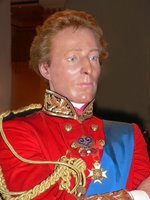
Arthur Wellesley, 1st Duke of Wellington, (c. 1 May 1769 – 14 September 1852) was an Irish born British soldier and statesman, widely considered one of the leading military and political figures of the 19th century. Commissioned an Ensign in the British Army, he would rise to prominence in the Napoleonic Wars, eventually reaching the rank of Field Marshal.

Wellington commanded the Allied forces during the Peninsular War, pushing the French Army out of Portugal and Spain and reaching southern France. Victorious and hailed as a hero in England, he was obliged to return to continental Europe to command the Anglo-Allied forces at Waterloo, after which Napoleon was permanently exiled at St. Helena. Wellington was victorious over Napoleon and the French at each of six major battles, confirming his place as one of history's greatest generals and strategists.

Despite oft-cited similarities between Napoleon Bonaparte and Wellington, the strategies and tactics employed by both were diametrically opposed. Perhaps the main reason that Napoleon stands in many history texts above Wellington is that Napoleon offered radical changes in warfare in every respect, whereas Wellington's contribution to warfare lies more in the brilliant use of the old.

Napoleonic tactics were typified by massive conscript armies who advanced in tight columns to rout opposing forces. This was soon adopted by nearly every major participant in the war, with the chief exception of the British as well as the Spanish and Portuguese they trained. In almost every engagement, the tight-packed French columns (in which only the first two ranks and outer edges could fire) would advance, apparently unheeding of casualties. Against the ill-trained and panic-prone armies of the Austrians, Prussians, and the other allied powers, it was spectacularly successful. Against the disciplined and trained British regulars who stood in line in two ranks (thus permitting every man in line to fire), the column was a spectacular failure. Despite the demonstrated helplessness of the French column against the British line, the French commanders in Iberia continued to attack in column. (Indeed, column attacks were used even at the Battle of Waterloo.) Thus, in many instances, a single British battalion would defeat an entire French division.

Wellington is often viewed as a 'defensive general', despite the fact that many of his greatest victories (Assaye, Douro, Salamanca, Vitoria, Toulouse), were all offensive battles. In fact, on the defensive, Wellington made a number of mistakes, most famously at the battle of Fuentes de Oñoro, where a disaster was only averted by his quick thinking and the steadiness of the British and Portuguese troops in retreating under fire.

Strategically, Wellington also appears somewhat anachronistic, with the Peninsular War revolving partly upon the possession and besieging of fortified strongholds. Conventional military wisdom of the era, especially under Napoleon, dictated that the opposing field army was to be eliminated at any price necessary, before disease and wastage could reduce the attacking force to nothing. In pursuit of this aim, desperate measures would be taken, such as winter battles, forced marches, and privation alleviated only by foraging. Wellington's campaigns instead displayed carefully planned offensives, supported by a magnificent supply train, and tempered by subsequent consolidation of gains.

In other strategic areas however, Wellington seemed to forecast the tide of the future. The construction of the fortifications near Torres Vedras, and the subsequent attritional campaign which ensued, seems to typify the manner that warfare would evolve within the following century. He also cooperated closely with the British navy, a necessity for success on the water-bound Iberian Peninsula.

Tactically, Wellington capitalized on the reforms of Sir John Moore and the Duke of York by creating large units of independent infantry, often armed with rifles, who fought in both regular and irregular fashion. His relationship with his cavalry arm — as well as his cavalry commanders — was infamously stern and demanding." - Wikipedia

I laughed when one of our tour guides pointed out that Wellington had a nude statue of Napoleon produced for his office. When Wellington was asked why the statue was nude, he replied "I needed something to hang my hat on!"

The Duke of Wellington was buried in St. Paul's Cathedral and there I saw his funerary monument when my sister and I attended Palm Sunday services. His sarcophagus lies in the crypt and can be seen on a regular tour of the cathedral when services are not in session.

Anne Parker's dolls are some of the most realistically sculpted portrait dolls I have ever encountered. So far, I am fortunate to have four of her dolls in my collection now. In addition to the Duke of Wellington, I also have Admiral Lord Nelson, Henry VIII, and Anne Boleyn.