Showing posts with label sculpture. Show all posts

Thursday, January 08, 2009

Asa Ames Wood Portraits featured in Williamsburg Exhibits

I see that the Abby Aldrich Rockefeller Folk Art Museum is hosting an exhibit of the 19th century portrait sculptures of artist Asa Ames. This picture of a delicate little girl named Amanda from the collection of Barbara Rice caught my eye immediately.

I had never heard of Mr. Ames before so I researched his work and learned that he was talented young man born in 1824 who was thought to have apprenticed with a carver of ship figureheads or trade figures. Sadly he died of consumption at only 27 years old. But he left behind a small group of his sculptures, thought to number only 12 to 13, that provide an intimate window into the lives of, mostly young, 19th century Americans.

Another of my favorites is this sculpture of a young man that is part of the permanent collection of the Huntington Museum of Art in Huntington, West Virginia. Although it is unsigned and undated, the work is thought to be the work of Ames because of stylistic similarities with other signed work. It is thought to have been produced in 1847. The Huntington Museum lends a little more insight into Ames short life:

"Asa Ames’s (1823-1851) story is a fascinating, and ultimately tragic, one of an early folk artist. He was born in New York State, probably near Buffalo. Though his early career cannot be traced with certainty, by 1847 Ames was residing in Albany with a family, for whom he carved busts of three children. This was to be the pattern for the rest of his short life. Apparently suffering from tuberculosis, he spent extended periods of time living with various family members and friends, carving busts and full-length sculptures of the younger members of the household, perhaps in exchange for medical care. His work, of gessoed and painted wood, was characterized by a direct frontality with great attention to detail and dress. Sadly, he was finally overcome by his illness, and he died at age 27.

The Huntington Museum’s Bust of a Young Man (ca. 1847), though unsigned and undated, can be attributed to Ames on stylistic and other grounds. An interesting feature is a circular hole into which some type of ornament was originally placed. It may have been a medallion recording an academic, athletic, or other achievement. Whatever it was, the prominence of its placement indicates great importance to its owner."

The American Folk Art Museum in New York exhibited his work and produced an wonderful slide show of some of his pieces.

Friday, December 26, 2008

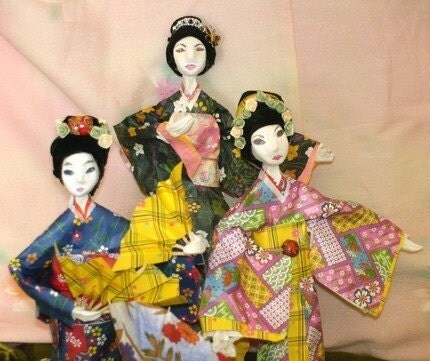
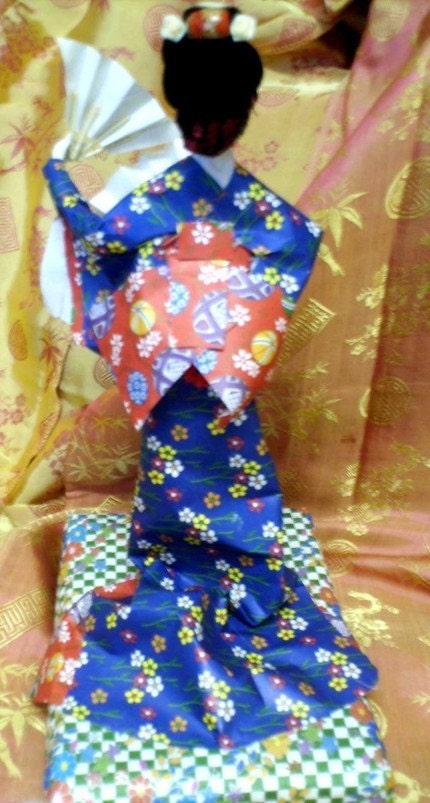
Colorful OOAK rice paper Geisha Dolls present interesting look at Japanese history


I think I could spend days doing nothing but exploring so many beautiful artist creations up on Etsy! These beautifully detailed geisha dolls created from polymer and colorful rice paper captivated me as soon as I saw them. I have several traditional geisha dolls that I purchased in Kyoto, Japan when I had the wonderful opportunity to visit there as a member of one of the first trade teams for alfalfa products (my husband and I were ranchers in eastern Oregon at the time) in 1982. Although my dolls have the traditional brocade silk kimonos, I loved the kaleidoscope of color and artful folding of the rice paper costumes of these dolls. Each of these dolls is produced as a OOAK made to each buyer's specifications. I also collect historical samurai warrior figures. I wonder if the artist has ever had a request for one of them?

"The 18th and 19th century produced in Japan an art, Ukiyo-e, representing the "floating world" --ephemeral, this was the world of the Kabuki theater, with its favorite actors and their fans, and of the Geisha.

Dolls were certainly loved by the geishas themselves, and were as fashionable as all their other pastimes. The name now given to a doll representing a child, Ichimatsu, comes from the name of an actor, and the first dolls of this type represented a male actor in his checked ("ichimatsu") costume.

As the floating world floated away in the 20th century, doll art still commemorates the beauties and beloved dramatis personae of the Ukiyo.

This is my lovely geisha, inspired by the traditional japanese 'paper dolls' and kimono dolls.

Her head, torso, hands and feet are sculpted of polymer clay. Her body is a wire armature, wrapped in cotton.

The geisha's kimono is entirely created from beautifully printed chiyogami rice paper.

Her face is handpainted, and her hair is made from rolled black velvet. She wears a 'comb' in her hair and a lacquer butterfly. "

A San Francisco artist, BlossomandWillow, works with clay, fabric and beautiful Japanese papers to create her geisha dolls.

"I find the art of Japan and the world of the geisha - what they call 'The Floating World' or 'Flower and Willow World' fascinating and drew the inspiration for my shop from that lovely concept. Here you will find original art and sculpture, as well as fine art supplies, lovely Japanese paper,and authentic vintage kimono and accessories from Japan."

Friday, June 20, 2008

Xanthos Kontis Dolls Appear on Ebay


I was browsing the current historical doll offerings on Ebay the other day and came across several historical dolls produced by doll artist Xanthos Kontis in the 1950s. What caught my attention was the facial detail of the Benjamin Franklin doll and the felt coat with painted details. Several years ago I purchased a Benjamin Franklin doll that looked very similar to the one offered on Ebay except the coat was burgundy colored. The Ebay vendor that sold me the doll said it was a doll produced for the country's bicentennial in 1976 but maybe they were mistaken.

I searched the internet looking for more information about Xanthos Kontis and didn't find anything except more listings for other dolls he produced like the Father Knickerbocker (a character from a Washington Irving novel), at right and Thomas Jefferson and Father Juniper Serra, below). All I could find about the man (??) was a Pittsburg obituary for someone named Xanthos Kontis Contaridis dated November 4, 1994. This could be the right person based not only on his name but that one of the dolls offered on Ebay is a portrait of William Pitt - a historical character rarely encountered. It would be natural for a historical doll artist to produce a doll of the local favorite son. If anyone has any additional information about this doll artist I would be interested to learn more.